Dominosa, Beyond Dominoes

Image by Mick Haupt from Unsplash
Dominosa is a fascinating logic game created by O.S. Adler in the late 19th century. Although placing domino tiles on a grid might seem simple at first glance, reconstructing the original layout of a complete domino set from a grid of revealed numbers poses a true combinatorial challenge.
The objective is to cover a rectangular board consisting of $R \times C$ numbered cells using a complete set of dominoes (from double zero $[0,0]$ to double $M$, $[M,M]$), such that each cell is covered by exactly half of a tile whose values match the numbers printed on the board.
Formal Problem Description
Given a complete set of domino tiles up to a maximum value $M$ (containing $N_d = \frac{(M+1)(M+2)}{2}$ tiles) and an $R \times C$ grid of numbers with $R \times C = 2 \cdot N_d = (M+1)(M+2)$ cells, we must place all tiles respecting the following rules:
- Unique tile usage: Each tile $[u, v]$ from the complete set (with $0 \leqslant u \leqslant v \leqslant M$) must be used exactly once.
- Complete, non-overlapping coverage: Each cell on the board must be covered by half of a single domino tile, leaving no empty spaces or overlapping tiles.
- Physical adjacency: A domino tile occupies exactly two adjacent cells on the board, either horizontally or vertically.
- Value matching: The two numbers on a domino placed over a pair of adjacent cells must match the values printed on those cells.
The key question we need to answer is: Does a valid placement of the complete domino set exist that perfectly covers the board, and how can we find it automatically?
Consider the following example (using tiles from 0 to 9 on a $10 \times 11$ board):
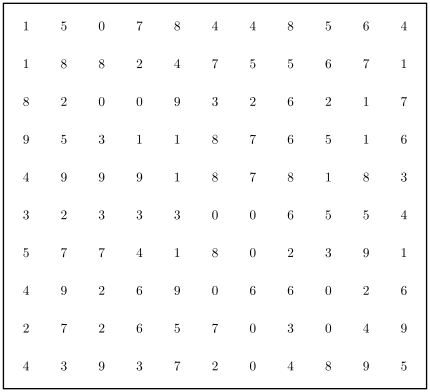
Do you dare to solve it logically before taking on the model?
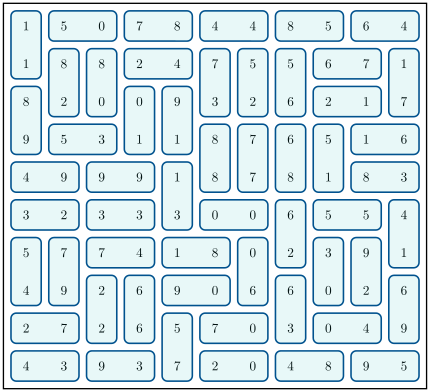
This logic puzzle can be formulated elegantly and systematically as a Binary Linear Programming problem. Dare to try it?
Want to keep exploring the world of Operations Research? Discover more posts on the topic here.
If you found this useful, please cite this as:
Martín-Campo, F. Javier (Jun 2026). Dominosa, Beyond Dominoes. https://www.fjmartincampo.com/blog/2026/dominosa/.
or as a BibTeX entry:
@misc{martín-campo2026dominosa-beyond-dominoes,
  title   = {Dominosa, Beyond Dominoes},
  author  = {Martín-Campo, F. Javier},
  year    = {2026},
  month   = {Jun},
  url     = {https://www.fjmartincampo.com/blog/2026/dominosa/}
}
Enjoy Reading This Article?
Here are some more articles you might like to read next: