Dominating the chessboard with queens

Image by Steve A Johnson retrieved from Unsplash
Unlike the famous 8 Queens Problem (where the goal is to place eight queens without them threatening each other), the Queens Domination Problem poses the inverse question from a spatial control standpoint: what is the minimum number of queens needed to attack or guard all squares on a chessboard?
In graph theory, this challenge is equivalent to finding the domination number ($\gamma$) of the queen’s graph. A square is considered “dominated” if it contains a queen or if it is within direct reach of at least one queen (in the same row, column, or diagonal).
Given a standard $8 \times 8$ chessboard, we must determine the smallest possible number of queens that can be deployed so that no empty square is left unattacked.
Would you like to try solving it logically before looking at its mathematical formulation?
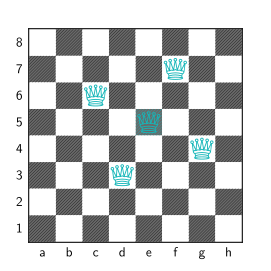
How do we translate this coverage of attack lines into a Binary Linear Optimization model?
Want to keep exploring the world of Operations Research? Discover more posts on the topic here.
If you found this useful, please cite this as:
Martín-Campo, F. Javier (Jun 2026). Dominating the chessboard with queens. https://www.fjmartincampo.com/blog/2026/queensdomination/.
or as a BibTeX entry:
@misc{martín-campo2026dominating-the-chessboard-with-queens,
  title   = {Dominating the chessboard with queens},
  author  = {Martín-Campo, F. Javier},
  year    = {2026},
  month   = {Jun},
  url     = {https://www.fjmartincampo.com/blog/2026/queensdomination/}
}
Enjoy Reading This Article?
Here are some more articles you might like to read next: